Many advanced Android apps hide their anti-tampering and anti-analysis checks
inside the .init_array. If you try to attach Frida normally, these checks run
and kill the app before your script even loads.
Here is how to deal with them.
What is .init_array?
Simply put: .init_array is a section inside an ELF binary (.so file) that
contains an array of function pointers.
The Android dynamic linker executes these functions extremely early—right
when System.loadLibrary() is called, and long before JNI_OnLoad fires.
Because it executes so early in the native lifecycle, it’s a prime spot for
developers to hide early anti-tampering mechanisms.
The Target App
To demonstrate, I built an example APK that triggers a native function inside
.init_array to toggle a boolean flag.
You can find the source code here
and you can download the apk file from the repository’s
releases.
Example Code
Let’s look at the example’s code.
initarrayexample.cpp
This is the native library’s code.
#include <jni.h>

// Simple global flag initialized to false
bool init_array_ran = false;

__attribute__((constructor)) void my_init_function() {
    init_array_ran = true;
}

extern "C" JNIEXPORT jboolean JNICALL
Java_com_example_initarrayexample_MainActivity_checkInitStatus(JNIEnv* env, jobject thiz) {
    return init_array_ran;
}
The code has two functions: my_init_function, which sets a flag to true, and
checkInitStatus, which returns the flag so the Java layer can check it.
MainActivity.java
package com.example.initarrayexample;

import androidx.appcompat.app.AppCompatActivity;
import android.os.Bundle;
import android.widget.TextView;
import com.example.initarrayexample.databinding.ActivityMainBinding;

public class MainActivity extends AppCompatActivity {

    static {
        System.loadLibrary("initarrayexample");
    }

    private ActivityMainBinding binding;

    @Override
    protected void onCreate(Bundle savedInstanceState) {
        super.onCreate(savedInstanceState);

        binding = ActivityMainBinding.inflate(getLayoutInflater());
        setContentView(binding.getRoot());

        TextView tv = binding.sampleText;

        if (checkInitStatus()) {
            tv.setText("Init Array Status: Ran!");
        } else {
            tv.setText("Init Array Status: Did NOT Run!");
        }
    }

    public native boolean checkInitStatus();
}
The code loads the native library initarrayexample, calls the native function
checkInitStatus, and displays on screen whether the .init_array function ran.
The Goal
We want to prevent my_init_function from changing the flag. We’ll do that by
hooking it and replacing its behavior using Frida.
A Note on Running These Scripts
Both scripts must be run in spawn mode, not attached to a running process.
By the time you attach to a running app, System.loadLibrary() has already
been called and the .init_array functions have already executed. Use:
frida -U -f com.example.initarrayexample -l script.js
The -f flag tells Frida to spawn the app itself, giving your script a chance
to set up hooks before any native libraries load.
First Attempt
Now we’ll decompile the APK and native library using jadx and Ghidra, find the function’s offset, and hook it using a generic native hook.
If you want to learn more about setup, Java, and native hooking, I recommend noobexon1’s blog.
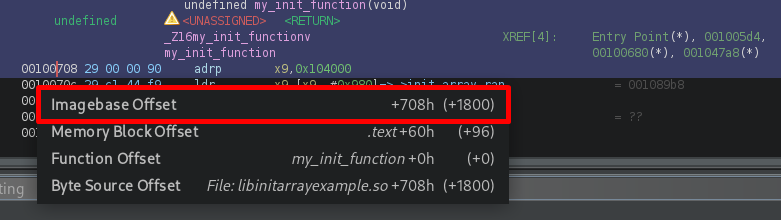
First, let’s check the function’s offset using Ghidra:
Now let’s hook it using Frida with a generic native hook, replacing the function’s behavior with an immediate return.
script1.js
(function () {
    const targetLibName = "libinitarrayexample.so";
    const functionRelativeAddress = 0x708;
    const functionName = "my_init_function";

    const dlopenAddr = Module.findExportByName(null, "android_dlopen_ext");

    if (dlopenAddr != null) {
        Interceptor.attach(dlopenAddr, {
            onEnter: function (args) {
                const loadPath = args[0].readCString();
                if (loadPath != null && loadPath.includes(targetLibName)) {
                    this.isTarget = true;
                }
            },
            onLeave: function () {
                if (this.isTarget) {
                    console.log(`[+] ${targetLibName} loaded!`);

                    const module = Process.findModuleByName(targetLibName);
                    if (module != null) {
                        const targetAddr = module.base.add(functionRelativeAddress);
                        console.log(`[+] Hook installed for [${functionName}]`);
                        Interceptor.replace(targetAddr, new NativeCallback(function () {
                            console.log(`[***] ${functionName} stubbed out @ offset 0x${functionRelativeAddress.toString(16)}`);
                        }, 'void', []));
                    } else {
                        console.log("[!] Failed to find module");
                    }

                    this.isTarget = false;
                }
            }
        });
    } else {
        console.log("[-] Failed to find android_dlopen_ext");
    }
})();
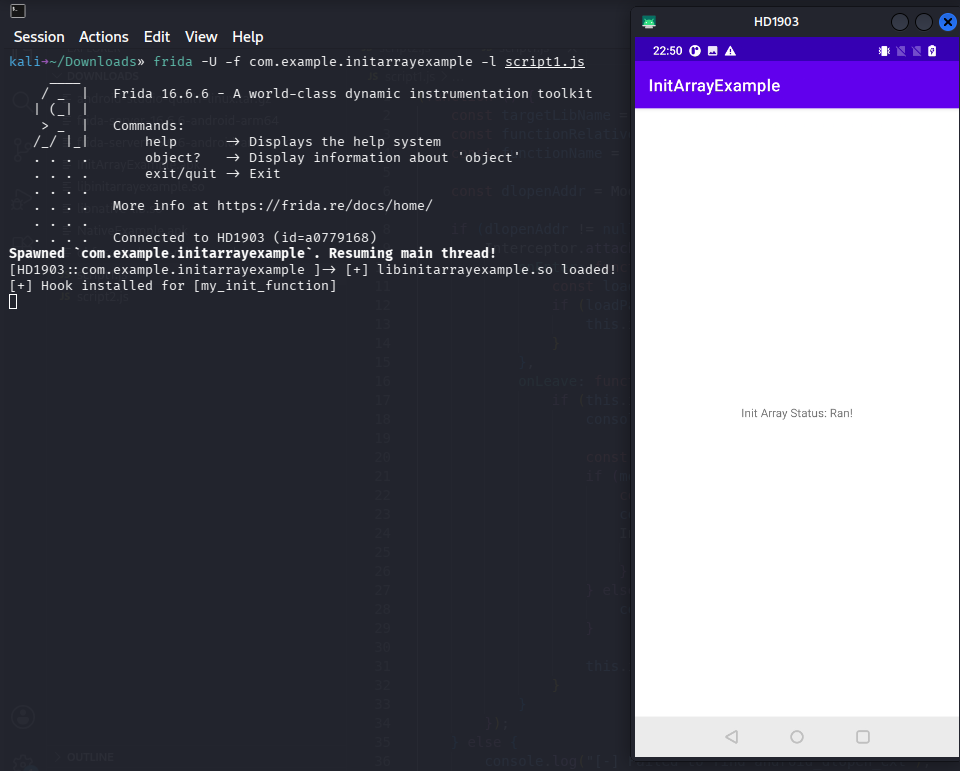
Frida did manage to hook the function, but the flag was still changed. Why? The answer is timing.
android_dlopen_ext is the function the Android runtime calls internally when
your app calls System.loadLibrary(). We hook its onLeave — meaning our hook
code runs after dlopen returns. But the linker runs .init_array functions
synchronously, inside dlopen, before it ever returns. So by the time
onLeave fires, my_init_function has already executed and the flag is already
set. We’re always one step behind.
To get ahead of it, we need to hook deeper — into the linker itself, before it calls the constructors.
Second Attempt
Instead of hooking android_dlopen_ext, we’ll hook the linker’s internal
call_constructors function, which is called synchronously during library
loading right before .init_array functions execute. This gives us a window to
replace my_init_function before it runs.
script2.js
const TARGET_LIB = "libinitarrayexample.so";
const TARGET_OFFSET = 0x708;

function hookInitArrayFunction() {
  const linker = Process.findModuleByName("linker64");
  if (!linker) {
    console.error("[!] linker64 not found");
    return;
  }

  const sym = linker.enumerateSymbols().find(s =>
    s.name === "__dl__ZN6soinfo17call_constructorsEv"
  );
  if (!sym) {
    console.error("[!] call_constructors not found");
    return;
  }

  console.log(`[*] call_constructors @ ${sym.address}`);

  let isHooked = false;
  Interceptor.attach(sym.address, {
    onEnter(args) {
      if (isHooked) return;
      // args[0] is a pointer to the soinfo struct for the library being loaded.
      // At offset 0x10 inside soinfo sits a pointer to the library's load address,
      // which we use to locate the module.
      const moduleBase = args[0].add(0x10).readPointer();
      const mod = Process.findModuleByAddress(moduleBase);
      if (!mod?.name.includes(TARGET_LIB)) return;

      console.log(`[+] ${mod.name} about to run constructors`);
      isHooked = true;

      const targetFunc = moduleBase.add(TARGET_OFFSET);
      Interceptor.replace(targetFunc, new NativeCallback(function () {
        console.log(`[***] ${TARGET_LIB} init_array function stubbed out @ offset 0x${TARGET_OFFSET.toString(16)}`);
      }, 'void', []));
    },
  });
}

hookInitArrayFunction();
Note on C++ name mangling: The linker is compiled as C++, so
call_constructorsis exported under its mangled name__dl__ZN6soinfo17call_constructorsEv. It also has helper lambdas whose names contain the substringcall_constructors, such as__dl__ZZN6soinfo17call_constructorsEvENK3$_0. We match on the exact mangled name to avoid accidentally hooking one of those helpers.
Now let’s run it:
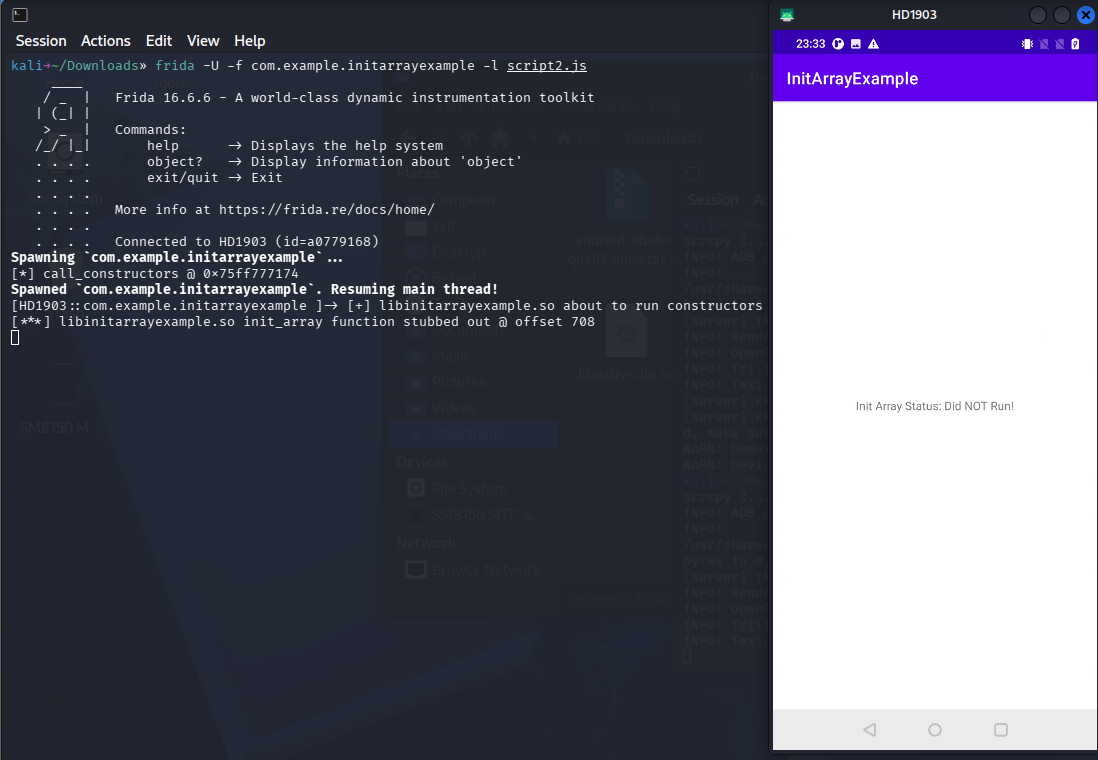
This time it worked — we hooked the function early enough to prevent it from changing the flag.
Template
Here is a ready-to-use template for hooking any .init_array function:
template.js
// == CONFIGURE THESE ==
const TARGET_LIB = "lib<name>.so";  // TODO: target library name
const TARGET_OFFSET = 0x0;          // TODO: offset of the .init_array function from the library base
// =====================

let hooked = false;

function hookInitArrayFunction() {
  const linker = Process.findModuleByName("linker64");
  if (!linker) {
    console.error("[!] linker64 not found");
    return;
  }

  const sym = linker.enumerateSymbols().find(s =>
    s.name === "__dl__ZN6soinfo17call_constructorsEv"
  );
  if (!sym) {
    console.error("[!] call_constructors not found");
    return;
  }

  console.log(`[*] call_constructors @ ${sym.address}`);

  Interceptor.attach(sym.address, {
    onEnter(args) {
      if (hooked) return;

      // args[0] is a pointer to the soinfo struct for the library being loaded.
      // At offset 0x10 inside soinfo sits a pointer to the library's load address.
      const moduleBase = args[0].add(0x10).readPointer();
      const mod = Process.findModuleByAddress(moduleBase);
      if (!mod?.name.includes(TARGET_LIB)) return;

      console.log(`[+] ${mod.name} about to run constructors — installing hook`);
      hooked = true;

      const targetFunc = moduleBase.add(TARGET_OFFSET);
      Interceptor.replace(targetFunc, new NativeCallback(function () {
        console.log(`[***] ${TARGET_LIB} init_array function stubbed out @ offset 0x${TARGET_OFFSET.toString(16)}`);
      }, 'void', []));
    },
  });
}

hookInitArrayFunction();
Run it in spawn mode:
frida -U -f com.example.yourapp -l template.js